Showing posts with label adm. Show all posts

Tuesday, June 22, 2010

Using EMF to control Eclipse plugins development rules

This week I am in Minneapolis to attend an OMG Technical Meeting.


Today I participated to the 2nd Eclipse & OMG Symposium where I talked about MoDisco and how we support the specifications defined by ADM, the OMG task force working on Software Modernization. I presented an example where we use KDM (Knowledge Discovery Metamodel) and SMM (Structured Metrics Metamodel) to control the quality of Eclipse plugins.

We wanted to check automatically some rules which are mandatory by the yearly synchroneous release:
  • Version number ends with « qualifier »
  • Source code must use ICU4J classes
  • The project must contain an « about.html » file
  • Packages name should start with the plug-in Id
  • Plug-in must not contain JARs files
  • Plug-in should contain only one « message.properties » and « Message.java » files
We also wanted to check some rules that we had defined internally at Mia-Software:
  • “PLUGIN_ID” variable of “Activator.java” should be initialized with the plug-in Id
  • Plug-in Id and Project name should be equal
  • «Bundle-Vendor» property value of « MANIFEST.MF » should be « %providerName »
  • « plugin.properties » should declare a « providerName » property
  • «Bundle-Name» property value of « MANIFEST.MF » should be « %pluginName »
  • « plugin.properties » should declare a « pluginName » property
Of course, we could have implemented these rules by using the APIs provided by the plugins already provided by Eclipse (org.eclipse.core, org.eclipse.pde, org.eclipse.pde, etc). But all these APIs are not homogeneous, and it is not always easy to find the right API to use. That's why we decided to experiment an other approach.

Our idea is to use these APIs only to create EMF models of the plugin. Then, once the models are created, we can implement the rules by using only EMF APIs.


In our case, we have used MoDisco to create seven EMF models:
  • A KDMSource model describing the organization of the plugin project (files and directories)

  • A Java model describing the Java source code of the plugin
  • A Manifest model to describe the content of the MANIFEST.MF file
  • Two XML models to describe the content of the .project and .classpath files
  • Two KDMCode models to describe the content of the plugin.properties and the build.properties files
These models contain all the information required to check the rules listed below.

Rather than directly displaying the violations found in an Eclipse plug-in into the Eclipse Problems View, we use an SMM model to represent the result of the analysis. Then, we have developped a generic tool which displays each rule violation contained in this SMM model into the Eclipse Problems View.
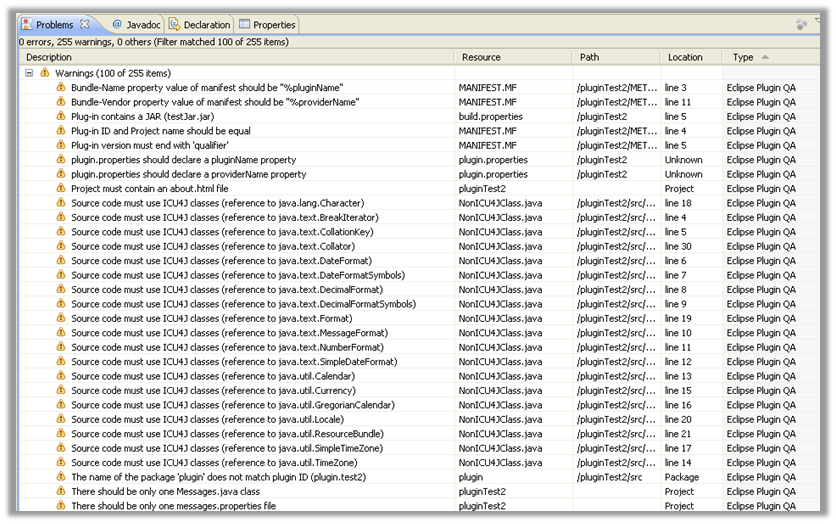

The benefit of this approach is that you just have to know EMF APIs to implement the rules, or use any EMF-compliant tool (such as OCL, ATL or QVT). Another benefit is that the result (the SMM model) is independent from how you want to deliver it to the user. Here we have injected the violations into the Eclipse Problem View, but we could have generated an Excel file or populated a tool such as Sonar.

I have still some little things to improve in this plugin, and I'll try to to commit it this summer as a use-case in MoDisco.

Meanwhile, the complete presentation is available on slideshare.


Thursday, April 22, 2010

Architecture-Driven Modernization Case-Studies


William Ulrich and Philip Newcomb have recently published "Information Systems Transformation, Architecture-Driven Modernization Case-Studies", a reference book on Software Modernization.

This book has been written by two of the most active members of the Architecture-Driven Modernization task force, the OMG initiative which aims at defining standard specifications for the modernization of existing software systems. They first introduce Architecture-Driven Modernization technologies, standards and approaches. Then they have compiled ten detailled case-studies on real modernization projects on various business domains (bank, administration, tourism, air-trafic management, combat system) and technologies (COBOL, VB6, Powerbuilder, ...).

With Gabriel Barbier (Mia-Software), Yves Lennon (Sodifrance/SoftMaint) , Hugo Brunelière and Frédéric Jouault (INRIA/AtlanMod) we have written one of these case-studies.

In this chapter we first describe the modernization process and tools used by Sodifrance to migrate Software Systems. The approach has been imagined and protyped thanks to a collaboration established in 1993 bewteen Sodifrance and Jean Bezivin, from University of Nantes, who was working on the representation of existing software systems with a technology based on sNets, a first generation of model engineering platform.

The sNets technology was immediately used by Sodifrance to develop a semantic discovery tool, named Semantor, to analyse any COBOL program and provide a fine-grained level of information about its internal structure and data. This tool is still evolving and has been renamed Mia-Mining.

In parallel, at the end of 1998, based on the experience gained in the rebuilding of an insurance company’s contract management system, where modelling and tailored code-generators were successfully used, Sodifrance started developing its own model transformation technology. From this work, in association with Jean Bezivin who brought his knowledge about early work at OMG on MOF, was born Mia-Studio, a model transformation tool to develop and run model-to-model transformation rules and model-to-text generation templates.

With these tools, Sodifrance has progressively built a chain which can be used on architecture migration projects, to transform existing applications from client-server to n-tiers and SOA architectures.


This chain is composed of three main steps:
  1. Extraction of a comprehensive model (the initial model) of the existing application from its assets (source code, configuration files, development repositories, etc).
  2. Transformation of the model of the existing application into a comprehensive model of the target application (the target model).
  3. Generation of the source code of the target application from the model of the target application.
To illustrate how this chain can be used, the chapter describes a project conducted by Sodifrance to migrate an application from VB6 to JEE for Amadeus Hospitality the leader in IT solutions provided for the tourism and travel industry.

The initial application, named RMS (Revenue Management System), was developed in VB6, and was performing queries on an Oracle database. It was composed of 300 screens, 200 of them displaying charts (pie charts, bar charts or line graphs). The VB6 code was composed of 306,000 source lines of code, VB6 code in 216 classes and 261 modules.


The migration project was completed by Sodifrance in 1,600 man-days with ten engineers over a year. The transformation of all the VB6 code (access to data, business rules and interface) was 80% automated, while the definition of the screens (Forms) was only 50% automated, due to the necessity to redesign them for a web mode. The new version of RMS is now composed of about 300,000 lines of code in 1,000 Java classes and 310 Jsp (Java Server Pages).


In the last part of the chapter, we present MoDisco, the Eclipse project dedicated to software modernization. This project has been created by AtlanMod during Modelplex, a research project funded by the European Community.

Because of the widely different nature and technological heterogeneity of legacy systems, there are several different ways to extract models from such systems. MoDisco proposes a generic and extensible metamodel-driven approach to model discovery. A basic framework, including implementations of OMG standards such as KDM or SMM, and a set of guidelines are provided to the Eclipse contributors to bring their own solutions to discover models in a variety of legacy systems.
One of the first industrial use cases using MoDisco has been the understanding of a Large Scale Data Intensive Geological system for WesternGeco, a geophysical services company