Thursday, May 31, 2012

Modeling P&C Insurance Products, the MAIF Case-Study

EMF (Eclipse Modeling Framework) is mostly used to create model-driven tools for software or system engineers. Here, in this case-study, an EMF-based tool is directly used by business domain experts to create models which are deployed and interpreted at runtime.

MAIF is a french insurance company with 2.8 millions of insured members (ranked 5th in number of insured vehicules and habitations in France).

They needed a tool to get a structured, centralized and unified vision of the P&C (property and casualty) products (IARD in french for Incendie, Accidents et Risques Divers).

The goal was to provide to insurance business experts a dedicated tool to specify their marketing offers and the caracteristics of their products. 

The solution is a product catalog composed of:
  • a product workbench (based on Eclipse) to define and administrate the products structure
  • a repository to store the models
  • a business rules engine (based on JRules) to manage and execute the rules related to the products
Accessible via services the catalog is used to manage production version of contracts and claims.


The structure of the catalog, developed with the assistance of Capgemini and Obeo, is based on an Ecore model which defines the P&C products concepts (catalog, product, coverage, risk object, provision, option, etc) and the way they can be composed.


The product workbench is used by MAIF P&C experts to define the products and administrate their life-cycle.


It provides graphical representations to create, modify, consult, version and validate the products.


These GMF diagrams are graphical representations on EMF models describing each product. They have been specified with Obeo Designer

They selected Obeo Designer in order to speed-up the definition of the important number of GMF views to develop and to facilitate their maintenance.

Additional developments have been done in Eclipse to finalize the workbench:
  • RCP customization to simplify the workbench (menus, toolbars and views) according to the kind of users
  • integration of LDAP to authentificate the users and manage their roles (product manager, validator, ...)
  • integration of SVN to manage collaborative work on products

The models created by the workbench are directly consumed by the IT system through distributed services (progressively remplacing legacy ones).

Without the need of specific IT developements, the deployment of new products is reduced from several weeks to about one week.

This new approach increases the agility of P&C products deployment by reducing the gap between business experts and IT.

    You can find a more detailed description of this case-study, written by MAIF, on www.obeonetwork.com, in the case-studies section of Obeo Designer group (registration required).


    Thursday, May 24, 2012

    Creating a new Ecore model with Obeo Designer 6.0

    One of the cool things coming with Obeo Designer 6.0 is the new "Ecore Modeling Project" creation wizard.


    It automatically creates an EMF project containing an Ecore model and its corresponding genmodel. This project is also created with the Modeling Project nature and a Obeo Designer representation file (.aird) containing a diagram (depending on the viewpoint selected with the wizard).


    This diagram is automatically opened and you can directly start graphically design your Domain Model.


    Once you have defined your packages, classes, attributes, relations, ... you just have to open the genmodel and generate the EMF code. Of course you can customize the genmodel to introduce your own generation choices.

    This video demonstrates this new wizard on a simple Ecore model.


    Monday, April 16, 2012

    Performing multi-viewpoint analysis : Thales case-study

    From now, on this blog, my posts mainly described case-studies where model-driven engineering (MDE) has been used to produce code or modernize existing software systems.

    Another domain where MDE is widely used is System Engineering. In this domain, Thales has acquired a strong experience with the Arcadia approach.

    Arcadia is a model-based architecture engineering approach which has been tooled up in Eclipse with Melody Advance, a generic workbench developped  by Thales Engineering & Process Management with the assistance of Obeo.

    Based on EMF and GMF, Melody Advance allows other Thales entities to create their own modeling tools. These modeling tools are declared with a dedicated DSL which is interpreted to dynamically provide the corresponding GMF modeling editors coming with ergonomic facilities and supporting large models.

    Arcadia has been presented at MD Day 2011 by Jean-Luc Voirin, the System and Software Engineering Director of Research & Technology at Thales Aerospace & Mission Systems Division.

    This approach has several objectives:
    • To perform early validation of key architectural aspects to decrease the rework in design and production
    • To improve the quality of architecture by taking better descisions regarding complex but necessary architectural trade-off
    • To capitalize on both product definition and know-how by supporting negotiation and compromise between stakeholders

    For Arcadia, Thales has integrated and extended several standards such as AADL, DoDAF, NAF, UML or SysML and added specific viewpoints to support:
    • Operational analysis
    • Functional analysis
    • Logical architecture
    • Physical architecture
    • Non functional constraints
    • Non functional trade-off
    • Transition to software or hardware

    Arcadia tooling provides several editors for these viewpoints and allows the system architects to graphically design and analyze a system.


    System architects can evaluate their candidate architectures againts industrial constraints (cost & schedule, performance, safety, maintenability, product policy, etc). For each kind of constraint, layers can be applied on diagrams to graphicaly highlight the violated constraints.


    Thanks to Melody Advance technology, this tool is easily customizable: Thales can define its own graphical representations and validation rules.

    Initially developped to target signal processing, data processing and information systems, Thales detected much larger fields where Arcadia could be used such as electrical power systems or thermal systems.

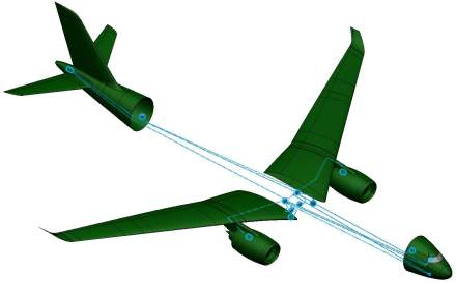
    For example, it can be used to work on several interleaved multi-physics models of a new airplane:
    • a Power Model describing electrical generators, loads, converters, etc
    • a Thermal model describing turbines, compressors, valves, etc
    • a Command & Control model describing interfacing units, computing unit, data, etc


    Specific viewpoints on these models can help the enginers to evaluate the solution architecture and detect problems before the IVVQ (Integration, Verification, Validation, Qualification) phase :
    • power and thermal performance depending on flight phase consumption
    • redundancy rules
    • failure scenarios and propagation
    • reconfiguration issues
    • early identification of spatial arrangement constraints impacting the architecture
    • etc
    For Jean-Luc Voirin, one of the main benefit of this approach is to avoid exhaustive modelling. With the multi-viewpoint tooling, the architects can adjust modelling effort on major engineering issues.

    The slides of the talk given by Jean-Luc Voirin can be found on Obeo Network (registration required).


    Tuesday, June 28, 2011

    Eclipse Demo Camp in Nantes

    Thursday 30/06 in Nantes, AtlanMod, Obeo and Mia-Software will organize an Eclipse Demo Camp.

    The program is rich with the presentation of seven projects coming with the Indigo Simultaneous Release.


    Four of these projects are developped in Nantes!
    • MoDisco (Model-Driven Modernization)
    • ATL (Model to Model transformation)
    • EMF Facet (Non-intrusive metamodel extensibility)
    • EEF (Model extended editors)

    The three other projects which will be presented are

    The Demo Camp will start at 6:00 PM at Ecole des Mines de Nantes.


    Monday, June 20, 2011

    Step in Toulouse

    This week, I'll be in Toulouse, the aerospace city.

    Wednesday (June 22), we will start the Obeo Designer Roadshow, a serie of six steps in six different cities (Toulouse, Brest, Nantes, Paris, Niort and Lille).


    Each step of this roadshow will be organized in two parts: the morning will be dedicated to a presentation of the version 5.0 of Obeo Designer, presentations of case-studies by users and a panel to discuss about graphical DSLs.

    The afternoon will be more technical with Hands-On sessions: we have asked to each person to come with a case, and we will help them to implement their own graphical designer during the afternoon.

    In Toulouse, the case-studies will be presented by Pascal Roques of PRFC and Tristan Faure of Atos Origin.

    Thursday (June 23), I will attend Eclipse Party (the Indigo Demo Camp) and give a talk about JavaEE code generation with EEF and Acceleo.


    This Demo Camp, will be very intensive with two tracks and a lot of interesting talks (Topcased, Koneki, Closure, Birt, RCP, eGit, SWTBot, e4, etc).

    There will also be a specific session about feedback from EclipseCon 2011 (XText, Orion, CDT, Tycho).

    Finally, it will end with a panel about Eclipse and its ecosystem, animated by Gaël Blondelle of Obeo.

    Wednesday, March 16, 2011

    How to follow Obeo at EclipseOn 2011?

    EclipseCon 2011 starts in less than one week from now.


    This year, Obeo will be well represented with five of us going to Santa-Clara:
    - Etienne Juliot, Vice-president and co-founder of Obeo, member of the Eclipse Foundation Board
    - Cédric Brun, CTO of Obeo, member of the Architecture and Planning council, leading several Eclipse/Modeling projects
    - Mariot Chauvin, committer on Acceleo, GMF and SWTBot
    - Mikaël Barbero, EMFPath project leader
    - and me ;-)


    The program will be very intensive for us, with seven talks to give:

    We are also in competion with five Eclipse Community Awards finalists:

    However, we don't forget the most important thing at EclipseCon: sharing ideas (and beers) with other Eclipse fans!


    Wednesday, March 2, 2011

    Using viewpoints to edit complex models

    Based on GMF, Obeo Designer adds several viewpoint mechanisms which facilitate the edition of complex models.

    One of the main difficulties with graphical representation of complex models is the number of nodes and edges visible on a same diagram.

    Obeo Designer comes with the concept of layer which allows to select the types of graphical elements to display. Inspired from image manipulation tools, several layers can be defined on a diagram and optionally selected or unselected, depending on what the user wants to see from his model.

    Based on the simple Family scenario (detailed in my previous post), this demo shows how to define layers for parental and brotherhood relationships.


    Another way to reduce the models complexity, is to use tabular representations. With Obeo Designer it is possible to define custom tables representing elements of the model. The lines and the columns are fully customizable depending on the objects and which properties have to be displayed.

    This demo, shows how to define a table representing members of a family. Columns contain the names of the parents and other columns contain the numbers of sons, daughters, brothers and sisters.