Showing posts with label eclipsecon. Show all posts

Monday, October 27, 2014

Let's Practice Sirius: BOF Session at EclipseCon

Like last year at EclipseCon, the Obeo team will organize a BOF session about Sirius.
https://www.eclipsecon.org/europe2014/bof-session/lets-practice-sirius

It will take place Wednesday the 29th in Silchersaal.


(A BOF (Birds of feather) is an informal discussion group of members interested in a particular issue).

If you already know Sirius, you can come with your first Sirius modeler. But if you just want to discover this technology, you can also come with your own work (an Ecore metamodel, an Xtext editor, etc). Finally, you can also come empty-handed to start from scratch with an example provided by the Obeo team.

During the BOF session, 10 USB keys will be provided containing Sirius bundles (linux, mac and windows) and the resources corresponding to a basic tutorial.

If you plan to attend this BOF and don't want to loose time installing Sirius, you can already find these bundles and resources here: https://filetransfer.obeo.fr/browse.php?parent=38896

Friday, October 24, 2014

Multi-Viewpoints on EclipseCon Program

To demonstrate Sirius on short talks, I'm used to create a modeler from scratch, in ten minutes, on a topic that everybody in the audience knows: the conference they are attending.

For Eclipse Con Europe, I decided to extend this demo in order to illustrate one of Sirius' main feature : the possibility to present the same model according to different concerns.

Using Ecore Tools (based on Sirius), I created a small modeling workbench based on this DSL.


Based on this DSL, my new Conference modeling workbench provides four different representations : 3 diagrams and a cross-table.

Track Diagram

This diagram allows me to create tracks and talks, thank to the tools in the palette. For each track, I can define its speakers, the day of the talk, its location and at what hour it will be given.

Here I have created the talks by Obeo and Thales.


The container presenting each talk has a conditional style : its color depends on its duration (green if the duration exceeds 35 mn).

When populating this diagram, Sirius creates EMF objects based on the conference DSL. They can also be seen in the Model Explorer.


I have also defined two optional layers on this diagram: "Sirius" and "Speakers". Each layer allows me to dynamically change the appearance of displayed objects.


When activated, the "Sirius" layer highlights the talks containing Sirius in their title: the Sirius icon is displayed as a to-right decorator on the concerned talks, and the other talks are colored in gray.


When de-activated, the "Speaker" layer hides the speakers.


Location Diagram

This other diagram automatically presents the same talks grouped according to their location.


Days Diagram

This last diagram presents the talks grouped according to the days.


Program Table

Finally, I have also defined this table which shows the program in a classical tabular way:


Behind the scenes

These representations are simply defined without any line of code, thanks to Sirius declarative mode.


The elements of this tree define which instances of the DSL are displayed in each representation and with which graphical style.

For example, the element TalkContainer allows to display all the instances of Talk which can be retrieve through the talks reference of the current track.


Its style is defined by the Gradient white to light green element which sets the shape, the color and the label of the talk.


Friday, October 25, 2013

Launching Sirius

At Obeo, the last weeks have been very busy to launch Sirius.


Now it's done!

Sirius is here with:
  • An updatesite available from the Eclipse infrastructure
  • The integration in the Luna release train
  • A brand new website: www.eclipse.org/sirius
  • New videos


The team is ready for EclipseCon Europe 2013!

Thursday, October 4, 2012

On the road again!

Once again, Obeo will hit the road with its hot new technologies and products in the bag.
We will meet with our partners, customers and technical community through three main events.

Obeo Designer Roadshow 2012


After the success of 2011's edition, we will organize a new roadshow which will pass through 4 cities in France:
  • Nantes (18/10)
  • Toulouse (15/11)
  • Paris (20/11)
  • Grenoble (6/12)
Each day is free and composed of two parts:

The morning, we will present how custom graphical designers can help in managing complexity and how to create this kind of tools with Obeo Designer. Then, we will let our partners and customers to present case-studies where they have used Obeo Designer. For the first date, in Nantes, case-studies will be presented by MMA and Thales Services.

The afternoon, is dedicated to a "hands-on" session. We encourage each participant to come with its own idea of a graphical designer. And, with the help of Obeo experts, we promise that everyone leave with a first version of a running designer!

Last year, participants left with designers for robots, SOA systems, IT infrastructure, authorization management, etc...


Enterprise Architecture Morning


The 16th of October, we will be in Paris to discuss about Enterprise Architecture.

The morning is free and will be composed of 4 main parts:

  • Obeo's approach to Enterprise Architecture
  • Case-Study by Choregie, in the Insurance domain
  • TEAP, a collaborative research project with Capgemini and DCNS.
  • SmartEA, the solution proposed by Obeo


At the end, we will keep time to allow participants to install SmartEA on their PC and to play with a sample model.


Obeo SmartEA allows Enterprise Architects to define their existing and target architectures (As-Is and To-Be), to evaluate gap analysis and define transformation scenarios. It provides:
  • a graphical environment based on Eclipse to edit TOGAF models
  • a viewpoint technology based on Obeo Designer to create new kinds of representations
  • a database repository to store the models and to allow collaborative work (technology based on Eclipse CDO)
  • connectors to federate existing information with the repository
  • architectural tools to study evolution plans and to analyze their impacts
  • a web client to navigate and to search into the models

EclipseCon Europe 2012


Last but not the least, like each year, Obeo will be present at Ludwigsburg (Germany) for the annual Eclipse conference in Europe.

EclipseCon Europe 2012


Obeo has been selected for 8 talks:


Saturday, March 27, 2010

Back from EclipseCon 2010

I came back to home today, after one week at Santa-Clara, near San-Francisco, attending my second EclipseCon.

Last year, I only presented a poster. But this year I gave a talk about MoDisco and I participated to the Modeling Project runway organized by Kenn Hussey. Gabriel Barbier, my colleague from Mia-Software, had also a talk with Henrik Lindberg about B3 and the possibility to use MoDisco to extract build information from source code .


Once again, I really enjoyed the conference and its organization: lots of interesting talks, very good keynotes (Steve Harris show was THE event of the week), but most of all it is the best way to share ideas, to meet people and to show what we working on.

This year, we spent a lot of time explaining a project we propose to create. The EMF Facet project will provide mechanisms to dynamically extend ECore models: adding properties, references, operations without changing the initial ECore model. These mechanisms have already been developped as part of the MoDisco project. We propose to externalize them to make them more reusable by other projects. We received very good feedback on this project from all the Modeling Project members to whom we presented our ideas and the existing components. We will first submit the proposal to the Modeling PMC next week.

Wednesday, March 24, 2010

Reverse-engineering of JUnit tests


Tuesday I presented MoDisco during two EclipseCon sessions at Santa-Clara:

We decided this year to illustrate MoDisco with a example based on JUnit :
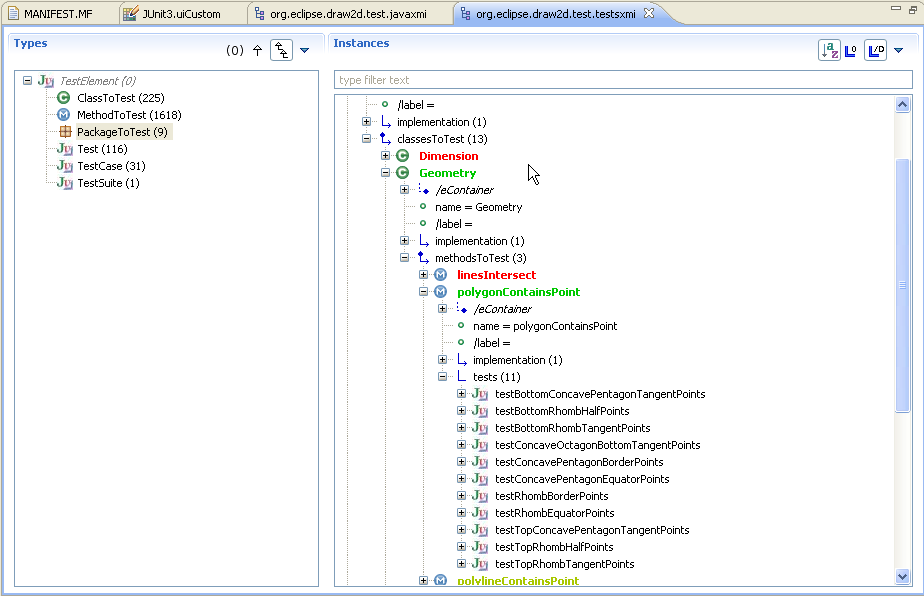
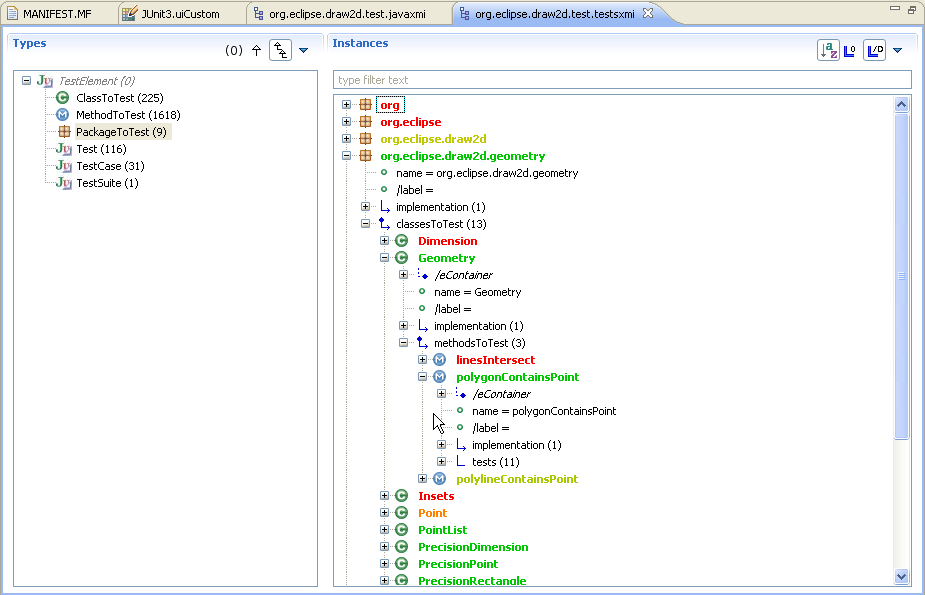
  • reverse-engineering of source code containing JUnit tests (we took draw2d as a sample)
  • creation of a fine-grained EMF model describing the source code
  • definition of an extension (Facet) to find the JUnit Test suites, Test cases and Tests contained within the code


  • colorization (UICustom) of the packages, classes and methods to be tested, depending on how many tests are defined for them


  • transformation of the EMF model and regeneration of the source code to migrate from JUnit3 to JUnit4
The slides are available here.

I will blog soon to give more details about this JUnit use-case.